Citizen science projects involve public participation in and engagement with science. This Flow-MER Friday webinar features case studies from Dr Munique Reid, Gwydir River System and Darling and Warrego River Systems Area-scale projects & Prof. Robyn Watts, Mid-Murray River System Area-scale Project.
Webinars and Presentations
All these recordings are available below for you to search and view. Search by presenter name, topic, Theme or Area to find a video of interest to you and treat yourself to your own science conference.
Citizen science & science communication in Flow-MER
|
Applying Flow-MER findings to our work: Perspectives and reflections from the Commonwealth Environmental Water Holder (CEWH)
|

The Flow-MER Program plays a critical role in supporting the work of the Commonwealth Environmental Water Holder. As the Flow-MER Program enters its next five-year journey, this presentation will reflect on the success of ten years of continued investment in science, while looking to the future under the next phase of the program.
The Golden Ticket: Understanding the role of flow on golden perch movement and population dynamics at a basin scale
|

Golden Perch Macquaria ambigua are a native fish species distributed widely across the lowland rivers of the Murray-Darling Basin (MDB), with the species known to undertake long-distance movements over 100s to 1000s of kilometres when unrestricted by barriers. While environmental flows are increasingly used to enhance movement of golden perch, knowledge gaps remain specific to the spatio temporal dynamics of these movements, how they are influenced by flows, and how such movements influence population dynamics at both regional and the MBD scale. In response to such, the Basin-scale fish theme’s research portfolio had a strong focus on understanding the role of flows in governing movement of golden perch across the MDB and how this movement influences the population dynamics.
Breathing roots, shifting waters: Tracking tree evapotranspiration in response to hydrological dynamics
|

Join us for a journey over the last 15 years to understand why measuring water use of riverine trees, using sap flow and water balance methods, provides a robust way to investigate the capacity of trees to respond to altered hydrology. Hear how this method is moving away from the traditional condition index metrics that have been used, to an improved understanding of a tree community’s adaptive capacity to respond to change and when they might be heading to an altered state and require intervention.
What have we learnt through 10 years of Flow-MER?
|
Basin-Scale Reflection: Professor Ross Thompson
|
Reflections from the Commonwealth Environmental Water Holder
|
What does the future hold for Flow-MER?
|
Species conservation in the age of uncertainty
|

Globally, freshwater vertebrates are declining rapidly, four times faster than their terrestrial counterparts, due to threats like habitat loss and invasive species. This presentation will discuss the challenges faced by threatened species in managed floodplains and explore the potential of environmental water management in conservation efforts.
Flows, fish and connectivity
|

This talk will explore work undertaken through Flow-MER examining basin-scale flow regimes and hydrological connectivity. This will set the context for a discussion about fish outcomes from the use of environmental water over nine survey years (2014–23). Current findings and learnings about flows, fish and connectivity from the Basin-scale evaluation will also be shared.
Environmental Water: Supporting the right plants in the right places
|

The vegetation that occurs along floodplains and wetlands is highly valued for the ecological and cultural benefits it provides. A combination of land use changes and flow modification has had a detrimental effect on the condition of vegetation across many of the world’s large river systems. Environmental flows are used across the Basin to improve the condition and diversity of floodplain and wetland vegetation. Our evaluation investigates the vegetation outcomes from the use of Commonwealth environmental water over the past 9 years in the Murray Darling Basin. We demonstrate a relationship between inundation regimes and the plants that we see in wetlands and floodplains and in doing so, show how environmental water is being used to maintain a diversity of important plant species across the Murray-Darling Basin.
Beating a path to ecosystem-scale evaluation
|

Shane will re-introduce the Basin-scale Ecosystem Diversity evaluation of Commonwealth Environmental Water in the Basin. He’ll reflect on the background and long-term results and identify significant challenges and opportunities that come from working at large landscape scales and some that are peculiar to management in the Basin.
Integrating technology into wetland vegetation monitoring
|

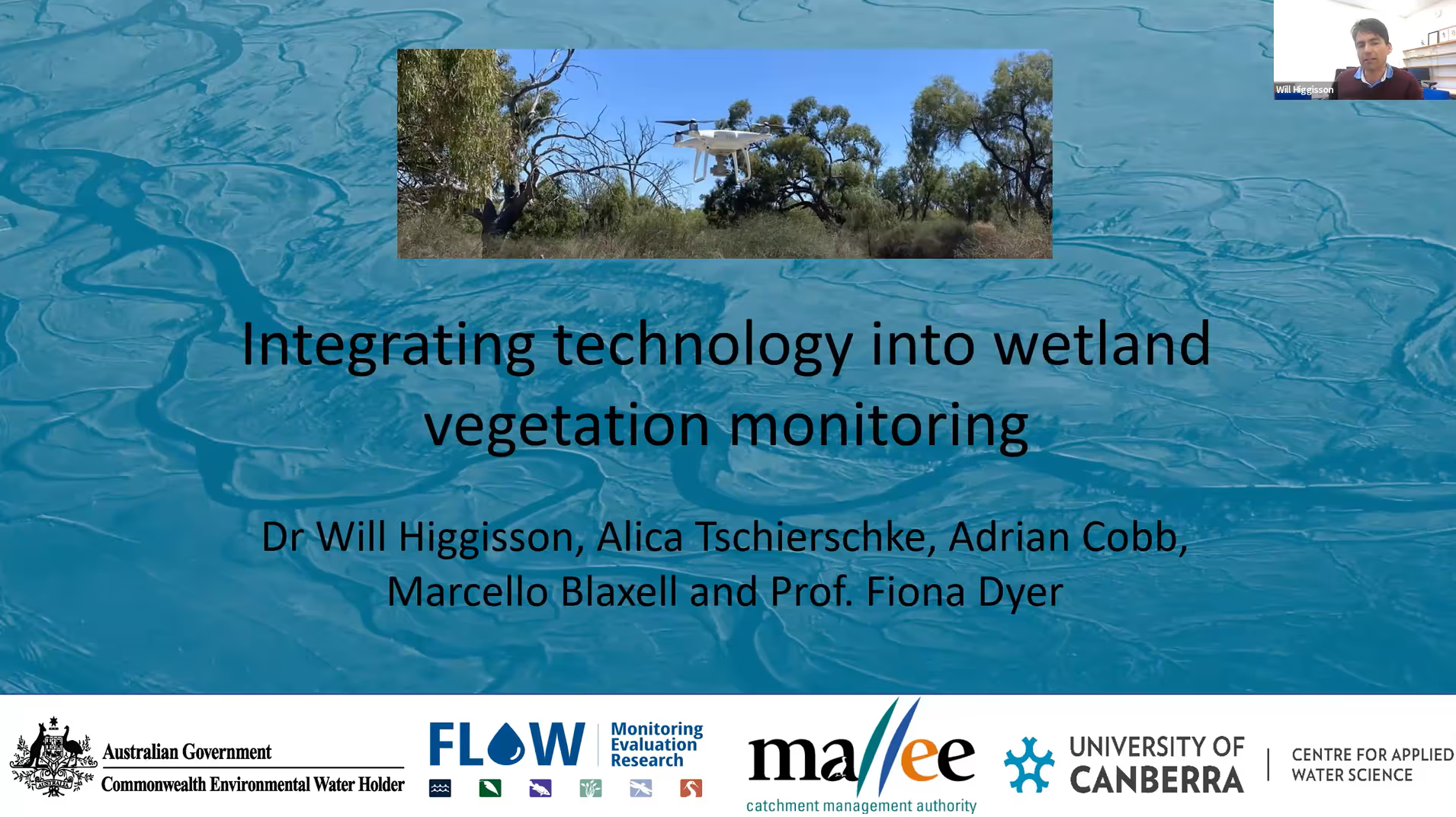
A multi-disciplinary team from the Centre for Applied Water Science at the University of Canberra have been developing methods to estimate wetland plants and their response to environmental water using drone imagery and machine learning. Dr Will Higgisson will present on a method developed to estimate the percent cover of common reed (Phragmites australis) and a measure of condition and cover of tangled lignum (Duma florulenta). This webinar will provide the background to this work, the processes we took, and the potential application of these methods.
Kamilaroi (Indigenous) Knowledge and Methodologies to Inform Water Management
|

The aim is to shift the research paradigm away from Indigenous peoples being the researched, under non-Indigenous research methodologies, to becoming the researchers. This allows the Indigenous scientist to derive the terms, questions and priorities of what is being researched, how the community is engaged, and how the research is delivered.
Spatial and temporal assessment of floodplain vegetation response to floods
|

The aim of this study was therefore to assess post-flood vegetation responses as a result of two key flood periods – 2016 and 2022. Multiple sources of remote sensing data was coupled with field measured evapotranspiration to identify inundation areas and assess tree condition.
Annual Forum 2023: Day Two Plenary – Dr Michelle Bald
|

Dr Michelle Bald Director, Evaluation and Reporting. Murray-Darling Basin Authority
Annual Forum 2023: Day Two Plenary – Dr Tony McCleod
|

Dr Tony McCleod Acting Executive Director, Basin Strategy and Knowledge Murray-Darling Basin Authority
Annual Forum 2023: Day Two Plenary – Hilary Johnson
|

Branch Head – Engagement, Monitoring and Southern Delivery Branch, Commonwealth Environmental Water Holder (DCCEEW)
Dancing to the beat of the Murray-Darling Basin
|

Effective management in the Basin requires an ear for music as well as coordination to bust a move at the right time!
Ontogenetic (simple to more complex) diet shifts by Murray cod in the Lower River Murray
|

For fishes, recruitment and cohort strength are influenced by survival through early life stages, which, in part, is determined by food availability. As such, knowledge of diet and key prey trophic interactions during early life stages, and how these are influenced by environmental parameters (e.g. river flow), are crucial for understanding population dynamics.
Getting the Biggest Bang for Your Duck:
|

The influence of hydrology on trophic dynamics and resource provision in a managed wetland to inform optimal water management.
When all else fails, just go with the flow: unintended lessons from an experiment in the Goulburn River
|

Experiments to augment channel retentiveness can increase detritus and dependent organisms and we attempted such an experiment in the Lower Goulburn River. Using established methods we increased retention at four sites by adding woody structure to treatment areas, but not control areas. Over 24 months, the experimental areas were sampled five times at baseflow (1000 ML / day).
Managing for non-stationarity in floodplain-wetland systems:
|
Enhancing monitoring and e-flow management: Insights from Flow-MER interviews and surveys
|

I have conducted interviews and surveys among scientists and managers, gathering valuable insights into their experiences, with monitoring and e-flow practices (using Flow-MER as a specific case study). The questions covered their perspectives on the monitoring’s role within e-flow programs, their overall evaluation of Flow-MER in various criteria, as well as identifying its most prominent strengths and primary drawbacks. I will present some of the interview and survey results during the Flow-MER forum. Additionally, I will conduct a live poll to prompt interactive discussions and gather the audience’s reactions regarding the outcomes of the research to date.
Timing of environmental water delivery influences extinction risk for chytrid infected amphibian populations
|

This work demonstrates how stochastic population models can be successfully used to assist water management decisions by calculating the extinction risk for endangered species under different water management scenarios.
Vegetation responses to flows with a novel drone-based monitoring technique
|

This presentation showcases a pilot project in which we developed and deployed a novel drone method tailored to detect changes in vegetation cover along riverbanks in response to flow events. By addressing the unique challenges of assessing riparian vegetation, where standard remote sensing techniques encounter difficulties, our novel drone approach represents a significant advancement.
Seeing through mud
|

Using mobile hydroacoustic sonar to monitor environmental watering outcomes.
Flow-MER firsts
|

Discussing the principles and science underpinning communications and engagement, and how to ensure our MER (Monitoring, Evaluation and Research) is relevant and impactful.
Novel assessment of trajectories of change in Murray-Darling Basin riverine tree ecosystems
|

We explore the utility of panarchy to interpret a ~30 year remotely sensed Normalized Difference Vegetation Index (NDVI) time series for two floodplain trees; Eucalyptus camaldulensis and E. largiflorens.
Fish-MER
|

Using our outputs to inform basin-scale management and guide future research.
Drones do the dirty work
|

New ways of monitoring can challenge our standard protocols, but also provide incredible insights, unexpected outcomes and opportunities for collaboration.
Waterbirds on the wing
|

How satellite-tracking of waterbird movements from the Murray-Darling Basin is informing water and wetland management.
A day by the Warriku
|

Sharing observations and learnings from a Culture to Science Day held on the banks of the Warriku (Warrego) River that brought together different ways of knowing and understanding our rivers.
Status of Flow-MER: Three years in with findings informing e-water policy and practice.
|
Annual Forum 2023: Welcome from the Commonwealth Environmental Water Holder
|
Oh, what a tangled web we weave: understanding the role of flows for food webs
|

Research carried out within the Environmental Water Knowledge and Research (EWKR) and Flow MER food web themes has sought to improve our understanding of the complex relationship between hydrology and aquatic food webs. In this session Paul will highlight some of the research that has arisen from the EWKR and other MDB projects that set the scene for research in Flow MER. James will provide an overview of a Basin-scale food web simulator that integrates knowledge of Basin food webs with long-term monitoring data to provide estimates of the contribution that environmental water is making to the biomass of key taxa groups.
Social and environmental challenges of scale in monitoring and evaluation
|

Large scale environmental monitoring and evaluation programs are increasingly common globally. As the scale of management and restoration increases a range of issues arise including cross-jurisdictional management, determining and enacting engagement at different scales and extrapolating outcomes. In large European rivers these have been approached in a range of ways, and the highlights of those programs will be extracted and compared to the approach taken in the Murray Darling Basin.
Condition, resilience and non-woody vegetation
|

As a vegetation ecologist, Cherie is interested in the maintenance and recovery of wetland and floodplain vegetation in river-floodplain ecosystems. Her PhD research with the University of Canberra, under the supervision of Fiona Dyer, Ross Thompson and Sam Capon, aims to rethink the way condition is used to envisage and evaluate non-woody vegetation responses to environmental flows.
Annual Forum 2022: CEWH Reflections
|

The Flow-MER program is fundamental to the planning, delivery and adaptive management of Commonwealth environmental water. Here are examples of how the Flow-MER program supports the Commonwealth Environmental Water Holder in their role to protect and restore the water dependent ecosystems of the Murray Darling Basin, and in sharing these learnings with Basin communities.
River Journey stop 7, The Warrego-Darling/Baaka
|

2021-22 was a year of two halves for the Warrego River and Western Floodplain, with low flows early on giving way to a wetter conditions. Flood-dependent vegetation communities responded well, as did lignum, coolabah and blackox which flowered and set-seed. For fish, some generalist species responded well while other species such as silver perch, freshwater catfish and Murray cod were found in low numbers.
River Journey stop 6, The Gwydir River system
|

High flows and targeted use of water for the environment have supported positive outcomes for waterbirds and vegetation in the Gwydir river system, with ~45,000 nests detected across 14 colonially nesting bird species, as well as high species diversity of plants and evidence of continued tree recruitment. Fish responses have been mixed and there are concerns for Murray cod and golden perch populations in the catchment and the broader Northern Basin.
River Journey stop 5, The Lachlan River system
|

Sometimes, choosing not to deliver water for the environment can be a good strategy too. By using environmental water in storage to underwrite the risk to the resource, water managers were able to maintain flows to support large scale waterbird breeding in the lower Lachlan catchment. Monitoring also showed that sites watered with environmental water during the dry years, saw vegetation bounce back better during high flows than sites which did not receive water.
River Journey stop 4, The Murrumbidgee River system
|

Many parts of the Murray-Darling Basin have seen large-scale waterbird breeding and the lower-Murrumbidgee wetlands have been a highlight. Monitoring waterbird nesting, breeding and survival is becoming increasingly sophisticated. See how drone technology and imagery is being used to more accurately monitor waterbird responses and how this is helping understand survival rates to inform water management.
River Journey stop 3, The Goulburn River
|

The Goulburn River can be heavily impacted by operational flows called Inter-Valley Transfers (IVT) – or water which is being transferred to the Murray to meet demands downstream. For the first time since this monitoring program began, IVT has barely been used in the water year, allowing scientists to obtain a good reference year for ecologically desirable flows. Fish and vegetation have responded very well as a result.
River Journey stop 2, The Edward/Kolety–Wakool River system
|

Attention in this part of the world has shifted to the Werai Forest which forms part of the NSW Central Murray Forests Ramsar site, but has been considered the ‘Forgotten Forest’. Genuine engagement with First Nations and community members are a strong focus, as scientist work with managers to bring water back to these forest environments and measure the benefits along the way.
River Journey stop 1, The Lower Murray River
|

Recent wetter conditions are enabling environmental water holders to build on high natural flows. The importance of water for the environment during the drought years is proving critical for maintaining end of system flows for salt export, habitat in the Coorong estuary, while benefitting riverine fish and fringing vegetation along the way.
Keynote Presentation: Basin scale Findings, Insights and Implications
|

Scientific evaluation and research at the Basin scale has improved our understanding of large-scale aquatic ecosystem responses to water for the environment, while also reminding us of the complexity of the Murray-Darling Basin. With both the Water Act and Basin Plan reviews coming up, there has never been a more important time for robust science to demonstrate the effectiveness of water for the environment and the Flow-MER program is delivering this.
Stakeholder perspectives on using water for the environment in the Edward/Kolety–Wakool river system
|
The role of environmental water and reed bed condition on the response of Phragmites australis reed beds to flooding
|
Using audio visualisations and other media to create engaging digital portrayals of wetland ecosystems
|
Methods to improve in-channel habitat and complement environmental flows
|
Basin-scale modelling framework development and demonstration
|
Role of winter environmental watering in supporting declining freshwater turtle populations
|
A spatial model to monitor the response of woody vegetation to environmental water
|
Regional and inter-regional fish movement responses to varying river discharge
|
Moving beyond ‘just add water’: perspectives on the challenges, needs and opportunities for environmental flows for vegetation outcomes
|
Monitoring range expansions following delivery of e-water using eDNA
|
Satellite tracking ibis and spoonbill movements to inform wetland and water management
|
Fish and flows in the MDB: Learnings from the Fish Theme Basin-Scale Evaluation
|

The Basin-scale evaluation describes fish responses to Commonwealth environmental water for 2019–20 as well as the cumulative outcomes since monitoring began in 2014 to answer the following evaluation question: What did Commonwealth environmental water contribute to sustaining native fish at the Basin-scale? In this webinar we discuss fish and flows in the Murray-Darling Basin, current findings from the Basin-scale evaluation and challenges and future directions for assessing fish population responses to flows.
Stakeholder perspectives on using water for the environment in the Edward/Kolety–Wakool river system
|

This webinar will provide an overview of social research undertaken by researchers from Charles Sturt University as part of the Edward/Kolety–Wakool Selected Area Flow-MER project. We have been undertaking research with a range of people (aka ‘stakeholders’) with an interest in the Edward/Kolety–Wakool river system to better understand social aspects of learning and adaptive management. We share some insights from this research, focusing on the results of a recent community questionnaire.
Why we need systems thinking to manage the MDB
|

Systems thinking means the whole is greater than the sum of the parts due to system interactions. This includes basin-scale hydrological and ecological interactions, interactions between the natural and human environment as part of a socio-ecological system, and coordination between organisations and stakeholders. We reflect on the substantive advances we have made over the last 10 years, as well as some of the big challenges that remain – including scaling through space and time, adapting to a changing climate, and enabling basin-scale coordination.
Biodiversity in the Basin
|

Freshwater ecosystems are biodiversity hotspots. In the Murray-Darling Basin rivers and wetlands support numerous rare and threatened species and are vital habitats for many migratory waterbird species. We introduce the frogs, reptiles, waterbirds, mammals and monotremes in the Murray Darling Basin and discuss how managed environmental water deliveries can support biodiversity.
Why modelling matters
|

This seminar will overview the modelling work being undertaken by the CSIRO and Deakin University team to develop methods to understand how improvements in hydrology translate into improvements in ecology. Danial and Ashley will discuss the tools and frameworks being developed to support extrapolation to unmonitored areas and the understanding of watering outcomes at basin-scales. Bruce will provide a CEWH perspective on how this modelling work will assist in their on-ground environmental water delivery.
Characterising environmental flows using hydrology
|

This talk provides an overview of the functional flows approach for the establishment of environmental flow requirements aimed at protecting multiple ecological endpoints and evaluating catchment conditions. It further discusses the integration of this approach in the Basin-wide modelling being undertaken in the Flow-MER project. Gavin Pryde from the Commonwealth Environmental Water Holder also talks about how environmental water requirements based on some of these concepts are used by water managers to inform planning and delivery.
What can reptiles and frogs tell us about environmental flow delivery
|

The benefits of flow delivery and environmental water are likely to aid many other wetland dependant vertebrates – including frog-eating snakes – so what can they tell us about water management? In this webinar, Skye, Damian and Erin share their learnings about wetland dependant vertebrates like snakes and frogs, and their relationship with the delivery of environmental flows.
Using environmental water to manage for resilience – the why, the how and the what and habitat use
|

Resilience is the ability of a system to ‘bounce back’ after it has been affected by disturbance. Murray Darling Basin rivers are constantly subject to disturbance from blackwater events, algal blooms, fire, drought, land-use change and water abstraction. One of the objectives of the Murray Darling Basin Plan is to manage for “Ecosystems resilient to climate change and other risks”.
Understanding trends of woody vegetation using field evapotranspiration and remote sensing
|

In this project we are using field collected water use data (evapotranspiration) for River red gum and Black box to calibrate the outputs of a Basin-scale remote sensing evapotranspiration model. Evapotranspiration is a surrogate for vegetation condition, and outputs of this model allow us to observe trends in vegetation condition from 2001 to current time, for each remote sensing pixel in the Murray-Darling Basin. Data can be observed at various intervals depending on the management questions, and include weekly, monthly, seasonally, annually (for example).
Fish population diversity and abundance in the MDB
|

The Fish Theme of the Flow-MER program is evaluating the contribution of Commonwealth environmental water to fish population diversity and abundance across the Murray-Darling Basin. In this webinar video, we discuss fish population models and integrated analysis of fish movement data to illustrate river system connectivity.
Co-designing engagement with Indigenous peoples for better environmental water delivery: Cultural Values, Protocols and an Indigenous Seasonal Water Calendar
|

This project will draw on Indigenous activities already underway within Flow-MER Selected Areas, as well as working closely with other Indigenous engagement activities within CEWH, MDBA and other programs. In this webinar, Brad and Emma discuss how the project: frames options and avenues for the engagement of Indigenous people across the seven Flow-MER Selected Areas, and incorporate their perspectives on Australian water management, with a particular focus on environmental water. draws on current knowledge and practice in regard to approaches and tools (including Protocols and Seasonal Calendars) for engaging with Indigenous water knowledge, values and interests. meets a need for contextual information and synthesis around Indigenous perspectives on water management.
Identification, characterisation and management of refuge habitat
|

As part of the Flow-MER Biodiversity Basin Theme, we are learning and understanding more about aquatic refugia habitats, their characteristics, and the species they support. This webinar video looks at the work being undertaken to locate refugia and identify how refuge habitats change over time.
Developing an environmental water energetics response model
|

As part of the Flow-MER Food Webs and Water Quality theme, we are developing a bioenergetic food web model by incorporating a range of existing and new data relating to food web dynamics in wetlands, flood channels and rivers during Commonwealth environmental watering. In this webinar, we talk about the model and how we plan to use it to demonstrate rates of carbon transfer and production in food webs under different environmental flow scenarios, exploring two key questions: 1. How does environmental watering influence the flow of energy through to vertebrate consumers such as fish and birds? 2. How can energetics response model support the prediction of trophic carrying capacity of rivers and wetlands in response to environmental water delivery?
Spatial and temporal scales of waterbird movements and habitat use
|

This webinar series is an opportunity to hear firsthand the activities taking place in the Flow-MER Program. Each video is presented by one of our team members who provide an insight into the latest findings and progress being made in their area of expertise.
Assessing soil and plants from the sky: A new era in waterway monitoring using drones
|

While at the moment some of you may be missing the inevitable dirt under the fingernails, the use of Unmanned Aerial Vehicles (UAVs) or ‘drones’ are changing our approaches and options. Drones have dramatically increased our ability to spatially assess waterway condition as it relates to specific characteristics of river flows. Geoff and Neil will provide an overview of techniques, analysis and opportunities, including relationships to hydraulics, with particular reference to current Flow-MER monitoring in the Goulburn River, Victoria, and Edward-Wakool, NSW. Daniel and David will reflect on how important this work is proving to be for on-ground environmental water management decisions.